
Picking a solar installer in Queensland comes down to five checks: who actually does the installation, whether the electricians are employed or subcontracted, who answers the phone after the job, what the workmanship warranty covers and who honours it if the company closes, and whether the reviews and the company's history are real. This guide explains each one, with the public registers you can use to check them yourself in a few minutes.
Why the installer matters more than the panels
Most panels and inverters sold in Australia come from a handful of large manufacturers, and they carry their own product warranties. What varies from one company to the next is the installation: how the system is designed for your roof, how it is wired into your switchboard, and who looks after it for the next ten or twenty years. Solar systems usually need little maintenance over a lifespan that can be up to 25 years, according to the Queensland Government, but when something does go wrong, the installer is the first call.
The Queensland Government's advice is direct: if something goes wrong with your solar power system, you should contact your solar power installer first. That only works if the installer still exists, still answers, and actually did the work.
Who actually installs the system?
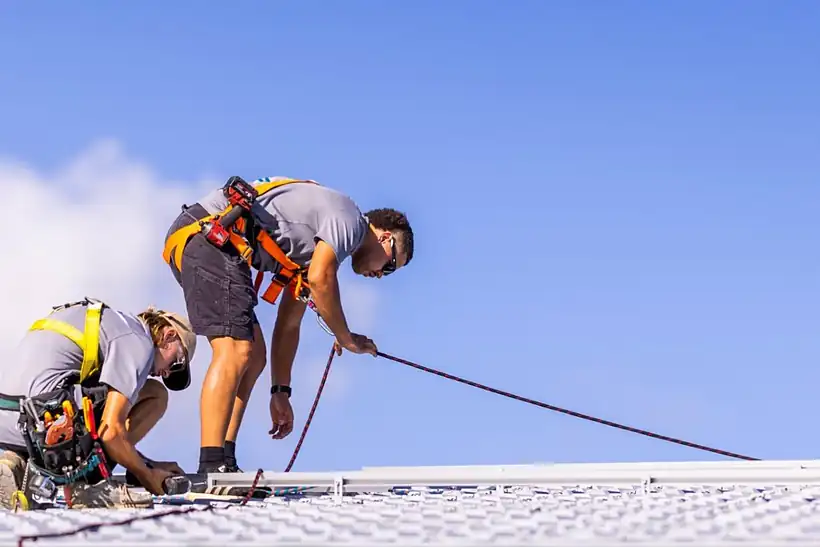
It is common in the solar industry for the company that sells a system and the people who install it to be different businesses. A retailer signs the contract, then passes the job to a subcontract crew paid per install. Many of those crews are skilled, but the arrangement creates gaps: the person on your roof did not design the system, and the company you paid did not do the work.
Ask the salesperson plainly: will your own employed electricians install my system, or a subcontractor? Ask for the electrical contractor licence number of the business doing the installation.
How LMS Electrical answers: LMS Electrical is an electrical contractor and does not use subcontractors. Its own electricians and apprentices, named on its team page, install every system. Its electrical contractor licence number, 80649, is published on every page of its website.
How do I check an installer's licence and accreditation?
There are three separate checks, and each takes a minute:
- Electrical contractor licence. In Queensland, electrical work must be done by a licensed electrician. The Electrical Safety Office advises you to look for the electrical contractor licence number and confirm it is current before agreeing to any work, using its online Electrical Licence Search.
- Installer accreditation. Solar installers must now be accredited by Solar Accreditation Australia (SAA), which accredits individual installers. The Clean Energy Council's consumer page links to the SAA service for checking whether an installer is currently accredited.
- Retailer code of conduct. The New Energy Tech Consumer Code (NETCC) lists Approved Sellers who have committed to its standards: honest, clear sales practices with no pressure selling, clear quotes and contracts, safe installation, and warranties honoured.
How LMS Electrical answers: LMS is listed on the NETCC register as an Approved Seller (as LMS Renewable Energy, a signatory since 18 April 2024, head office in Slacks Creek). Its team page names two directors and an electrician who are SAA qualified installers.
Where is the support line answered?
Before you sign, ring the number on the quote. Who answers? Is it the business that will install your system, or a general call centre? Many solar complaints start after installation, when an inverter shows a fault or a battery stops charging, and the owner cannot reach anyone who knows their system.
How LMS Electrical answers: LMS lists one Australian number, 1300 456 776, and an office and depot at Unit 1/12 Herbert Street, Slacks Creek, with its customer service staff named on its team page. It describes its support as "before, during and after installation".
What does a workmanship warranty actually cover?
A solar system comes with several warranties, from different businesses, and it helps to know which is which:
- Panel warranties come from the panel manufacturer, usually a product warranty plus a longer performance warranty on output.
- Inverter and battery warranties come from their manufacturers, and some can be extended.
- The workmanship warranty comes from the installer and covers the installation itself: the mounting, the wiring, the connections and the work done in your switchboard.
- Australian Consumer Law guarantees apply on top of any written warranty. Goods and services must be of acceptable quality and fit for purpose, and the business that sold them to you is responsible for that. The Queensland Office of Fair Trading explains your consumer rights.
The catch is that a manufacturer warranty claim usually needs someone to diagnose the fault, remove the faulty part and fit the replacement. That someone is normally the installer.
The warranty trap: what happens if the installer disappears?
When a solar company closes, its workmanship warranty usually closes with it. Owners are left with an orphaned system: the panels and inverter may still be under manufacturer warranty, but there is no one to make the claim, and another electrician has to be paid to diagnose and replace parts. Long written warranties are only as good as the business behind them.
The Queensland Government lists who can help if something goes wrong: your installer first, then your electricity retailer, the Energy and Water Ombudsman, the Office of Fair Trading, Solar Accreditation Australia, the Clean Energy Council, the New Energy Tech Consumer Code and the Electrical Safety Office. If your installer has gone, it is worth contacting the panel and inverter manufacturers directly, and using a licensed electrician who regularly works on solar for repairs. For anything unsafe, such as cracked panels, loose fittings or exposed cables, the Electrical Safety Office's advice is never to attempt repairs yourself.
How LMS Electrical answers: LMS has been installing since 2013 (its company has been registered since September 2013), offers a 10-year workmanship warranty from LMS itself rather than from a subcontractor, and services and repairs systems other companies installed.
Are the reviews real and recent?
Reviews are only useful if they are genuine. In 2015, the Federal Court ordered penalties against the companies behind Euro Solar and Australian Solar Panel for fake testimonials and false "made in Australia" claims, after action by the ACCC. Look for a large number of reviews on independent platforms, spread over years, including recent ones that describe specific jobs, suburbs and problems that were fixed.
How LMS Electrical answers: LMS has a 5.0 rating from 198 Google reviews and 4.8 from 96 reviews on SolarQuotes (checked October 2026). Every review quoted on its website is copied word for word, with a link to the source.
Is the company older than the rebate?
Battery rebates have brought a rush of demand. Queensland's Battery Booster rebate opened in February 2024 and the federal Cheaper Home Batteries Program started on 1 July 2025, and many solar businesses appeared around the same time. A new company is not automatically a bad one, but a business that was installing long before the rebates is more likely to be around when your system needs a service in year six. Check the company's ABN registration date on the Australian Business Register.
How LMS Electrical answers: LMS Electrical Pty Ltd has held its ABN since September 2013, more than a decade before the battery rebates arrived.
A checklist to take to any quote
- Who will install the system: your employees or a subcontractor?
- What is your electrical contractor licence number, and can I see it on the Electrical Safety Office search?
- Are you a NETCC Approved Seller, and are your installers accredited by Solar Accreditation Australia?
- Who answers your support line, and where are they?
- What does your workmanship warranty cover, for how long, and who honours it?
- Which panels, inverter and battery are on the quote, and who holds those warranties?
- Where are your reviews, and how many are from the last year?
- When was your business registered?
A good installer will be glad you asked. This guide is general information, not legal or financial advice.
Sources
- Queensland Government: Get started with solar
- Queensland Government: If something goes wrong with your solar power
- Queensland Government: Household solar system maintenance and inspections
- Electrical Safety Office: Electrical licence search
- Electrical Safety Office: Solar PV systems
- New Energy Tech Consumer Code: find an Approved Seller
- Clean Energy Council: for consumers (includes the Solar Accreditation Australia installer check)
- Queensland Office of Fair Trading: consumer rights, complaints and scams
- ACCC media release: penalty for fake testimonials and false solar country of origin claims
Checked 7 October 2026. LMS Electrical facts: NETCC register (checked October 2026), the Australian Business Register, and LMS's own published material.